





Are your marketing and sales teams working from the exact same playbook, or are operational silos quietly draining your software-as-a-service (SaaS) pipeline?
For fast-growing B2B technology companies, scaling revenue is rarely just a product challenge. It is an operational one. When your technology stack expands, your customer data fragments across multiple systems. Sales representatives waste precious hours manually tracking down prospect activity. Meanwhile, marketing leaders struggle to demonstrate real return on investment (ROI) beyond vanity metrics such as page views and ebook downloads.
 It can get messy.
According to HubSpot's State of Sales Report,
52.2% of sales professionals report that the biggest impact of sales and marketing misalignment is lost sales and revenue.
Furthermore, industry studies from LinkedIn Business Solutions reveal that
87% of sales and marketing leaders believe collaboration between both departments is what enables critical business growth.
Simply buying a market-leading Customer Relationship Management (CRM) platform does not instantly fix these alignment problems. Turning a platform into an active revenue engine requires a strategic setup tailored to complex buyer journeys.
Specialized HubSpot implementation services for tech companies solve this exact issue. Professional implementation structures your data, automates repetitive manual processes, and connects your revenue teams around a single source of truth. This way, you can avoid common HubSpot onboarding challenges.
What Are HubSpot Implementation Services for Tech Companies?
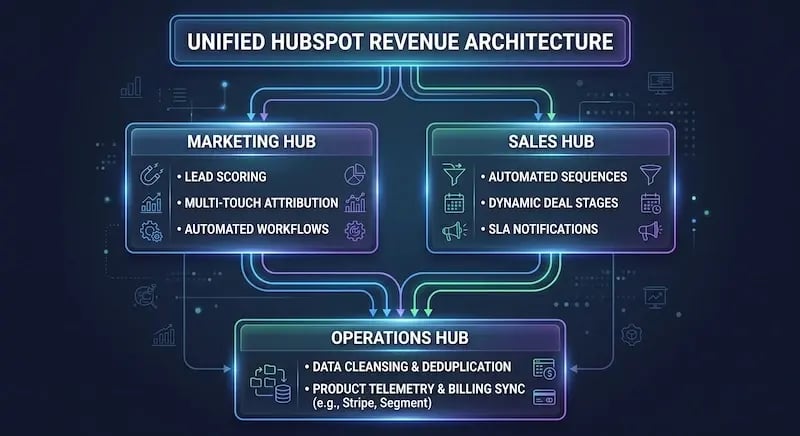
HubSpot implementation services for tech companies represent the specialized technical process of architecting, configuring, and integrating the HubSpot CRM platform to align with the specific growth motions of B2B software and tech scale-ups. Unlike basic out-of-the-box software onboarding, technical implementation encompasses custom data model design, product-led growth (PLG) data integration, custom pipeline creation, cross-departmental automation, and Revenue Operations (RevOps) alignment.
When tech companies invest in professional implementation, the goal is not merely software setup. The true objective is establishing a scalable infrastructure that turns raw prospect interactions into predictable revenue.
Why Standard CRM Setup Fails Fast-Growing Tech Companies
Why do so many out-of-the-box CRM deployments fail to deliver ROI for B2B tech organizations?
Most software platforms come ready to use right out of the box, offering generic deal stages, default lead forms, and standard contact fields. While a default setup might work for a traditional small business, tech companies operate under fundamentally different mechanics:
-
Complex Multi-Touch Buyer Journeys: Tech buyers involve long sales cycles, multiple stakeholders, free trials, demo requests, and technical security reviews. Default CRM properties simply cannot capture these nuanced touchpoints.
-
Product Telemetry and Trial Data: SaaS growth models rely on product usage signals, such as active users, feature adoption, and trial expiration dates. Out-of-the-box setups keep this critical product data trapped inside the application rather than giving sales representatives visibility into user intent.
-
Dirty Data and System Fragmentation: Without proper validation rules, duplicate contact records accumulate rapidly. Research by Gartner reveals that poor data quality costs organizations an average of $12.9 million annually in operational friction and lost opportunities.
Consider a real-world scenario. A growing cloud software startup signs up for HubSpot and relies on self-onboarding. Because their free-trial signup form is not connected to their core CRM properties, inbound trial users are categorized as generic subscribers rather than high-intent prospects.
Sales representatives continue to manually reach out to cold leads, while product-qualified users reach their account limits without being noticed. Because there are no automated alerts to notify account executives when a trial user completes key onboarding actions, the high-value enterprise pipeline simply evaporates.
A professional implementation changes this entire dynamic. Specialized implementation experts structure custom objects, build custom API connectors, and implement proper lead routing rules so your CRM mirrors your actual business operations.
The Technical Pillars of a High-Impact HubSpot Implementation
How does an expert implementation convert messy operational data into streamlined revenue growth?
By establishing four core architectural pillars inside your HubSpot account:
1. Unified Lifecycle Management and Behavioral Scoring
A successful implementation replaces guesswork with data-driven lead qualification. Implementation specialists set up clear criteria for every stage of your buyer journey:
| Lifecycle Stage | Operational Trigger | Automated System Action |
|---|---|---|
| Subscriber | Content download or newsletter opt-in | Enrolls leads in top-of-funnel educational email nurture sequence. |
| Marketing Qualified Lead (MQL) | Reaches behavioral score threshold (e.g., pricing page views + webinar attendance) | Assigns lifecycle status and notifies the marketing team for campaign tracking. |
| Product Qualified Lead (PQL) | Trial user exceeds engagement threshold (e.g., invites 3 team members) | Creates a deal record and triggers an automated internal task for the account executive. |
| Sales Qualified Lead (SQL) | Direct demo request or validated enterprise fit criteria | Triggers round-robin lead distribution rule to assign rep based on territory. |
HubSpot predictive scoring models combine explicit data (such as company size, job title, and industry) with implicit behavioral data (such as page visits, email clicks, and feature engagement). This ensures your sales team spends time exclusively on prospects ready for a sales conversation.
2. Cross-Hub Marketing Automation and Lead Nurturing
Static email blasts no longer move tech buyers through the funnel. Advanced implementation leverages Marketing Hub to build responsive, event-driven workflows.

When a prospect downloads a technical whitepaper on cybersecurity compliance, the system automatically adjusts their contact profile, registers their interest category, and branch-nurtures them with relevant case studies rather than generic marketing updates.
3. Sales Enablement and Pipeline Automation
Sales representatives should spend their days selling, not manually updating database fields. Through customized Sales Hub configuration, routine admin work disappears:
-
Automated Meeting Scheduling: Prospect meeting links map directly to reps' calendars and instantly update contact lifecycle status.
-
Dynamic Deal Stages: Pipelines reflect real buying milestones (such as Security Review, ROI Validation, and Legal Redlines) rather than arbitrary sales goals.
-
Real-Time Slack and Teams Alerts: Notifications alert reps the second a high-value account opens a pricing quote or returns to the website.
4. Custom API Integrations and RevOps Architecture
Growing tech companies rely on specialized software tools across their tech stack. Operations Hub bridges these platforms by offering custom JavaScript code actions and webhooks.
A dedicated implementation syncs your HubSpot CRM with your critical business tools:
-
Product Analytics Platforms: Segment, Mixpanel, and PostHog.
-
Billing and Subscription Engines: Stripe, Chargebee, and Zuora.
-
Customer Success Software: Zendesk, Gainsight, and Intercom.
Syncing billing data directly into contact profiles lets sales reps immediately identify expansion opportunities, upselling options, and churn risks without switching tabs.
According to financial analysis from Nucleus Research,
Well-executed CRM implementations yield an average return of $8.71 for every dollar spent by eliminating manual work and maximizing revenue visibility.
Bridging the Marketing-to-Sales Alignment Gap
How exactly does a customized HubSpot setup align two departments that historically struggle to work together?
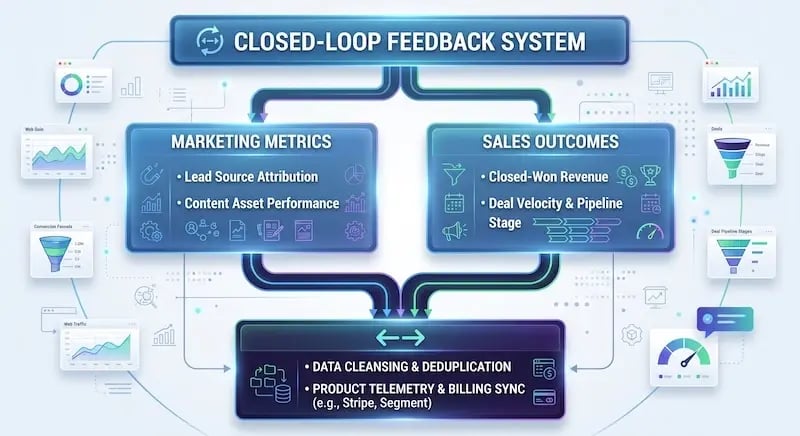
Alignment happens when both teams work from shared data definitions, clear handoff protocols, and unified reporting dashboards.
Establishing Service Level Agreements (SLAs)
Misalignment frequently occurs when marketing considers a lead "qualified" while sales views that same lead as a waste of time. An implementation partner facilitates formal Service Level Agreements directly inside the system.
For example, marketing commits to delivering 50 MQLs per month that match your Ideal Customer Profile (ICP). In return, Sales commits to reaching out to those qualified leads within two hours of assignment. HubSpot workflows enforce this SLA automatically by reassigning uncontacted leads and notifying sales managers when response windows slip.
Closed-Loop Reporting and Multi-Touch Attribution
Without closed-loop reporting, marketing teams celebrate campaign metrics while executive teams worry about missed ARR targets.
HubSpot implementation connects closed-won deals back to initial touchpoints. Revenue attribution models reveal precisely which marketing channels, content assets, and campaigns generated actual revenue:
-
First-Touch Attribution: Identifies which top-of-funnel channels bring new prospects into your ecosystem.
-
Multi-Touch Attribution: Spreads revenue credit across every interaction along the buyer journey, highlighting high-performing nurture assets.
-
Position-Based Attribution: Emphasizes the initial lead creation channel and the final conversion point before deal creation.
When both departments look at identical revenue dashboards, conversations shift from blaming lead quality to optimizing pipeline performance together.
DIY vs. Vendor Onboarding vs. Specialized Implementation
When evaluating how to deploy HubSpot, tech leaders generally choose between three distinct implementation paths.
Understanding these options ensures you select an approach that matches your internal bandwidth and technical complexity:
| Evaluation Factor | DIY (Self-Implementation) | Basic Vendor Onboarding | Specialized Implementation Service |
|---|---|---|---|
| Primary Focus | Quick platform access | Core software setup and feature training | Custom RevOps strategy, data architecture, and team alignment |
| Technical Integration | Basic native integrations only | Standard point-to-point connections | Custom API integrations, webhooks, and product data mapping |
| Process Optimization | Ad-hoc internal adjustments | Standard operational templates | Tailored sales pipelines, custom properties, and automated SLAs |
| Data Migration | High risk of duplicate data | Basic CSV imports | Comprehensive data cleansing, schema mapping, and validation |
| Time to Full Value | 6 to 12 months | 2 to 3 months | 4 to 8 weeks |
| Strategic ROI | Low (high operational friction) | Moderate (software adopted, processes unchanged) | High (maximized pipeline velocity and scalable ARR) |
Key Questions to Ask When Evaluating an Implementation Partner
Choosing the right partner is just as critical as selecting the platform itself. To protect your investment, ask prospective implementation partners these essential questions during your evaluation:
-
How do you handle custom data architecture and third-party integrations?
-
Ensure the partner possesses certified expertise across Operations Hub and API development rather than just basic front-end template design.
-
-
What is your methodology for defining lifecycle stages and SLAs?
-
Look for partners who run strategic discovery workshops to align your sales and marketing leaders before touching any software settings.
-
-
How do you ensure user adoption across sales and service teams?
-
Software is only useful if your team actively uses it. Your partner should provide role-based training sessions, custom video documentation, and post-launch support.
-
-
Can you show documented success with tech scale-ups?
-
Request case studies demonstrating how their implementation works directly to improve pipeline conversion rates, reduce sales cycle length, or improve lead-to-opportunity ratios.
-
Transforming Your Software Investment into a True Growth Engine
Deploying HubSpot CRM should never be treated as a simple software installation. For growing tech organizations, it represents a foundational opportunity to rebuild your go-to-market engine, eliminate operational friction, and position your revenue teams for long-term scale.
When you replace siloed tools and manual processes with a unified data strategy, your marketing team gains full visibility into campaign ROI, your sales representatives can focus on closing qualified deals, and your leadership team gains real-time data to make confident growth decisions.
At Aspiration Marketing, we specialize in helping growth-focused B2B tech organizations unlock the full power of HubSpot. As an accredited HubSpot Solutions Partner, our team blends deep RevOps expertise with hands-on technical execution. We don't just set up your software portal—we architect an end-to-end revenue ecosystem tailored to your unique sales motion, software integrations, and growth targets.
Is your CRM ready to support your next stage of expansion? Schedule a strategic consultation with Aspiration Marketing today to evaluate your current setup and build a scalable foundation for predictable revenue growth.




.webp?width=600&height=375&name=Choose%20B2B%20agency%20for%20EdTech%20(1).webp)


Leave a Comment
Have thoughts on this article?
Share your feedback, ask questions, or join the discussion with our community.