





Are your potential customers aware of the pain points that are quietly eroding their efficiency or revenue?
In the Buyer's Journey, the Awareness Stage is the first and most foundational phase where a person transitions from passively accepting a situation to actively recognizing a problem, challenge, or opportunity that requires investigation. Understanding what influences buyer decisions at this initial stage is critical, as it determines whether they even begin the journey toward finding a solution.
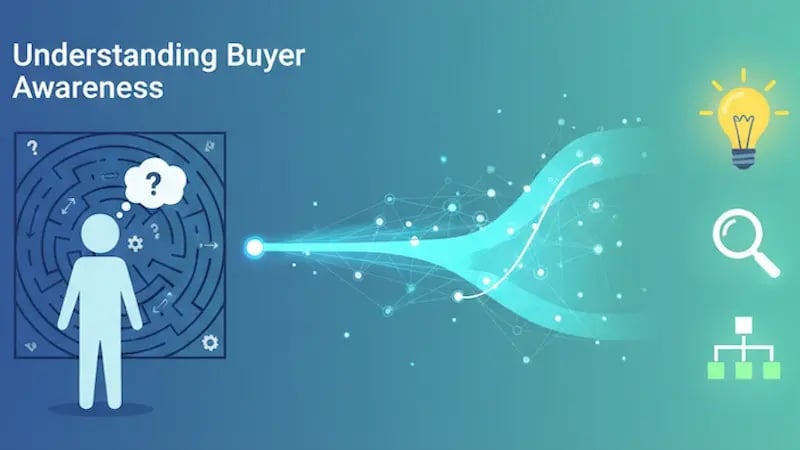 This is not the time for product pitches or pricing discussions. It is the time for validation, education, and subtle guidance. We must pinpoint the internal and external forces that drive this initial realization. We are going to explore the psychology of problem recognition, what fuels buyer research and awareness, and how your content can serve as the critical catalyst that starts the journey.
I. The Awakening: Defining the Awareness Stage Psychology
The Awareness Stage is governed by one core psychological shift: the buyer moves from ignorance to recognition. They can now clearly name the problem, but they are still far from naming a specific solution or vendor. This recognition process is rarely instantaneous; a combination of mounting friction and a definitive trigger usually drives it.
A. Internal Friction vs. External Catalyst
What causes this profound shift in awareness? We see that it's often a combination of mounting internal pressure and a sudden external event that acts as the catalyst:
Internal Friction: This is the slow, creeping realization that the current situation is unsustainable. It can manifest as consistently missed growth targets, high employee turnover rates, or a steadily escalating cost of operations. The pain is persistent, but the root cause is vague.
Example: A Chief Financial Officer (CFO) observes that their quarter-over-quarter profit margins have shrunk by 5% over the past year. They feel the financial pinch, but they don't know if the problem lies in staffing, software, or the supply chain. Their current awareness is limited to the symptom.
External Catalyst: This is a sudden, undeniable event that forces immediate, focused attention on the problem. This could be a competitor launching a disruptive service, a new government regulation taking effect, or an existing core system suddenly reaching the end of its lifespan. These events shift the problem from a low-priority frustration to an urgent mandate.
Example: A critical cloud vendor announces that it is sunsetting a key piece of software next year, forcing the IT Director to confront an urgent, undefined void in their infrastructure. This outside force dictates the urgency of the new awareness.
B. The Information Need: Validation, Not Solutions
In the Awareness Stage, the buyer is using content to validate their feelings and clearly define their vague problem. They are emphatically not yet searching for "Best CRM" or "Top Consulting Firm." They are asking foundational, exploratory questions, such as: "Am I the only one experiencing this 5% margin erosion?" or "What do industry experts call this specific Accounts Payable bottleneck?"
Content types that succeed here must serve as objective validators and educators:
Analyst reports defining specific industry challenges.
Thought leadership pieces that name and validate the common pain points.
Educational articles that clearly describe the symptoms and their common origins.
This initial validation—making the buyer feel understood and normalizing their problem—is the first, most fundamental step in establishing what influences buyer decisions to dedicate time and energy to a solution search.
II. The Forces of Discovery: What Truly Drives Initial Awareness
To capture a buyer in the Awareness Stage, you must understand the powerful forces that move them from passive acceptance to active research. These forces provide the emotional and rational hooks that move the user from symptom awareness to problem definition.
A. The Statistical Validation: Quantifying the Pain
Buyers need to know their problem is a widely recognized industry issue, not just a personal failure confined to their organization. Content must provide data that quantifies the severity of the challenge, turning an abstract frustration into a measurable business risk.
For example, your awareness stage content can address topics such as:
Growth Pain: Businesses that fail to align sales and marketing strategies see, on average, 10% slower revenue growth than those that succeed. When a Marketing VP reads this, their fuzzy awareness of "low sales" is validated as a definable "Sales-Marketing Alignment Problem" with a quantifiable cost.
Retention Cost: Highlight the expense of losing talent. The average cost of replacing a high-level employee can range from 150% to 213% of their annual salary. This statistic helps the HR Director realize their rising turnover rate isn't just a staffing nuisance; it is a serious, seven-figure financial crisis that demands executive attention.
Inefficiency: In large B2B sales cycles, sales reps spend only about 39% of their time actually selling. This data point provides the exact language for the Sales Director to explain the problem: they don't have a volume problem; they have an inefficiency problem caused by administrative overload.
By providing these credible, sourced numbers, you empower the buyer to articulate their need internally and gain crucial buy-in from other stakeholders.
B. The Fear of Missing Out (FOMO) and Competitive Pressure
The actions of industry peers and competitors are a primary external influence on buyer awareness. When a leading competitor gains a strategic advantage through digital transformation or process refinement, it forces other businesses to become acutely aware of their own operational gaps. This is the fear of falling behind.
For example, address:
Digital Lag: You can mention that 75% of consumers now expect a consistent, multi-channel experience from brands, and companies that fail to provide this are falling rapidly behind. This helps a retail manager understand their problem isn't just slow website performance; it's a systemic failure to meet modern customer expectations.
Actionable Insight: Your content should use anonymous competitive examples—"Leading industry peers are seeing 25% gains in operational speed by addressing X"—to introduce awareness of the opportunity cost of inaction. This approach uses the power of social proof and competitive pressure, a strong psychological influence, to spur the buyer into deeper investigation.
Market Disruption: Up to 40% of all companies on the S&P 500 list may not exist in 10 years if they fail to adapt to digitization and market changes adequately. This high-level statistic is compelling for the C-Suite, shifting their awareness from minor problem-solving to existential risk management.
III. The Psychology of Problem Recognition: Naming the Challenge
The primary goal of Awareness Stage content is to provide the buyer with the precise language they need to articulate their problem to their colleagues, subordinates, and executive leadership. This transformation from vague pain to a defined challenge is a crucial step in influencing buyer decisions to dedicate budget and time to the issue.

A. Guiding the Shift: Symptoms vs. Root Cause
Buyers typically enter this stage describing symptoms ("Our website traffic is low," "We are spending too much time processing invoices"). Marketers must use content to guide them toward the root cause that lies beneath the surface.
Scenario: A financial manager recognizes a symptom: "We are spending too much time processing invoices." Your blog content should highlight the root cause of this issue: "Your organization suffers from an outdated Accounts Payable workflow, leading to an average error rate of 5% and a processing time three times the industry standard." The buyer now has a specific, technical name for their problem.
Content Focus: Use clear, concise titles like "The Real Reason Your Marketing Automation is Failing" or "Is Shadow IT Undermining Your Security?" These titles directly suggest a hidden, systemic problem, appealing to the buyer's intellectual curiosity.
B. The Power of "Aha" Moments
Effective Awareness Stage content delivers small, manageable moments of insight—the "Aha" moments—that immediately validate the user's initial suspicion. This process fosters immense trust and positions your brand as a helpful and credible expert from the very beginning.
Key Content: Use diagnostic checklists, simple two-minute quizzes that reveal common pitfalls, or illustrative case studies that show relatable peers in the same situation. The content should make the buyer nod their head and think, "That's exactly what is happening to us."
Readability Imperative: Since the buyer is consuming this content quickly and independently, the structure must be easy to scan and comprehend. We use short paragraphs, clear subheadings, and bold text to ensure high readability and rapid comprehension of key concepts. This commitment to clarity is part of our strategy to maintain a Flesch Reading Ease score of 70 or higher.
IV. Actionable Content Strategies for the Awareness Stage
To effectively guide buyers through this critical realization phase, marketing content must follow specific, counterintuitive rules. These strategies must be simple, direct, and focused exclusively on facilitating discovery and problem definition.
A. Strategy 1: Mapping Content to Pain Points, Not Products
In the Awareness Stage, every piece of content must align with a specific pain point. It must avoid product mentions entirely. Any attempt to sell or promote a feature prematurely will destroy the hard-earned trust and cause the buyer to exit.
Example Contrast:
Premature (Solution-focused): "Why Our CRM is Better Than Excel."
Effective (Problem-focused): "The 5 Hidden Costs of Relying on Spreadsheets for Client Data."
The only "solution" you offer here is high-quality information. Your content is designed to answer the buyer's unspoken question: "What is the name of this problem and why is it happening to me?"
B. Strategy 2: Creating "Un-gated" Authority
Information in the Awareness Stage should be freely accessible and easily consumable. Gating resources (requiring an email address or form fill) creates unnecessary friction and assumes a level of commitment the buyer has not yet reached.
Trust Building: Note that 68% of consumers feel more positive about a brand that provides valuable, free content that helps them solve a problem. This willingness to give up-front value establishes credibility.
Actionable Step: Focus on highly readable blog posts, easily shareable infographics, and short, educational videos hosted on platforms like YouTube. The goal is maximum distribution, not immediate lead capture.
C. Strategy 3: SEO for Questions, Not Keywords
Buyers in the Awareness Stage use broad, symptom-focused searches. They search the way they speak, often asking fundamental questions (e.g., "high employee turnover causes," "how to calculate website traffic ROI"). Your SEO strategy must reflect this language.
SEO Focus: Optimize content for long-tail keywords focused on problems and questions, not features. Ensure the content clearly and directly answers the user's question to capture that initial attention. The keyword phrase "what influences buyer decisions" should be naturally integrated into text that discusses why buyers start searching for information. For example, "Understanding the internal and external forces driving this change is the key to knowing what influences those decisions to dedicate resources to research."
Guiding the First Step
Mastering the Awareness Stage means understanding that the initial realization of a problem is the most crucial and foundational step in influencing buyer decisions down the road. By validating their pain, quantifying the impact, and providing the language to define the root cause, you position your organization not as a vendor, but as the source of clarity and expertise.
This is a delicate process that requires precise execution and advanced analytics to track which pieces of content successfully elevate a user's awareness. Aspiration Marketing specializes in designing and executing highly effective Awareness Stage content strategies. We link the psychology of problem recognition with actionable, data-driven content mapping.
Utilizing powerful analytics and HubSpot-based tactics, we help brands become the trusted voice that guides the buyer from a vague symptom to a clearly defined problem, setting the perfect foundation for the rest of the Buyer's Journey.





Leave a Comment
Have thoughts on this article?
Share your feedback, ask questions, or join the discussion with our community.