





Many SaaS companies believe successful marketing campaigns require complex tactics and hefty budgets. However, the truth is, powerful conversions can be achieved through strategic planning and a focus on core customer needs.
This guide will equip you with five effective strategies that deliver results, regardless of budget size.
Picture your work day.
With the help of an identity and access tool like Okta, you log on to your secure network, ready to get to work. You may check your Microsoft Teams account and reply to messages from your colleagues who are already online. Then, you head over to your project management program, perhaps Asana, to delegate some tasks and pick up a few of your own. You prepare yourself for your first meeting of the day, which will, no doubt, require using a video tool like Zoom.
In just a few moments, you've relied on numerous software-as-a-service (SaaS) providers. Throughout your company and the workday, there are many more touchpoints with SaaS companies.
Your marketing team may be readying their monthly content with HubSpot. Your accounting team is paying out vendors with the help of enterprise management software like Workday. Your sales team is very likely tracking their leads through Salesforce.
Businesses estimate that 70% of the apps they use are SaaS. It's clear that SaaS has become integral to the workplace in 2024.
If you're trying to launch a SaaS product and build the same level of recognition and retention that many of today's biggest SaaS companies enjoy, here's everything you need to know about effective B2B SaaS marketing.
Understanding the Intricacies of SaaS Marketing
The idea of software-as-a-service (SaaS) has its roots in the time-sharing systems of the 1960s and 1970s, which allowed multiple users to access a single computer simultaneously. Software-as-a-Service (SaaS) is a software delivery model that provides the functionality of an application via the Internet. This model enables companies to eliminate the need to build, install, and maintain software locally, which saves teams time, money, and stress.
This contrast in functionality from traditional software is reflected in how SaaS marketing differs from conventional marketing. SaaS marketing is a specialized field of marketing focused on promoting and selling software-as-a-service products. Because it involves educating audiences about intangible and often complex products, SaaS marketers need to consider a few unique variables while creating their marketing plans, including:
- Targeting decision-makers and advocates: While plenty of B2B SaaS companies direct their products toward end users within a workspace, the more common strategy is to target businesses and their decision-makers, who may not use the software themselves. Another target is advocates who hold sway over purchasing decisions. Building relationships with these individuals can assist with retention, which can be a better goal than acquisition, especially for products with high prices and longer sales cycles. This means marketing materials must be robust enough to convince executives and other high-level gatekeepers that your product can meet their company goals.
- Drawn-out customer journeys: Because the offerings are intangible and usually complex (and pricey), SaaS products may require more time, demos, and educational materials to help prospective customers see the value. This means marketing and sales teams need to work together to tighten up their campaigns, and the entire go-to-market (GTM) division should be prepared for long and twisting customer journeys.
- Higher, more complex pricing: SaaS platforms are well-suited for subscription-based tiered pricing, which entails offering different feature sets at various price points. As robust platforms with a business audience, the pricing is also typically on the higher side. These factors mean that marketers must work hard to clearly delineate what each pricing package entails and target the right audiences with their messaging to not scare away any lower-budget shoppers.
How to Build a SaaS Marketing Campaign that Converts
Now, let's discuss creating an effective SaaS marketing campaign to help companies navigate new audiences, longer journeys, and higher pricing to distinguish themselves in the growing SaaS space.
1. Understand Your Buyer Personas
At the very top of your marketing funnel is, of course, the awareness stage. In decades past, one of the biggest tactics in the B2B marketing space during the awareness stage was cold calling. But you might want to hold that thought before you pick up the phone.
You may have heard it said that younger generations hate talking on the phone. That statistic is true, but it's particularly accurate for cold calling. Research indicates that millennials find phone calls to be time-consuming and anxiety-inducing. With millennials holding 73% of positions that make major purchasing decisions in B2B companies, it's vital that your B2B marketing goals target this population.
While this fact is not to suggest that there's no place for cold calling in the B2B marketplace anymore, it is to suggest that some companies may want to realign their marketing efforts with the younger generations they're targeting as they move into positions of purchasing power.

2. Establish Yourself as a Thought Leader First
To appeal to millennials and younger key decision-makers, it might be more fruitful to put more time into your inbound marketing efforts than outbound. When you invest in more inbound marketing strategies, like content marketing and search engine optimization (SEO), you'll find that more people will "stumble" upon your website during that crucial awareness stage.
Now, you have someone who is aware of your company and who is doing the research to solve a problem to which you might have the answer. By having something like a blog post as your first touchpoint, you're providing value to your potential customers. The next step is to move them from that touchpoint to consider making a purchase from your company.
3. Find Your "In"
After your inbound marketing attracts eyes to your company, you need to move your potential buyer further down the funnel. As a SaaS marketer, you know that the word "free" shouldn't be a frightening one. The bulk of your revenue likely comes from subscriptions, but how did you get to that point? For many SaaS products, the "in" is through free trials or tiers.
Consider, for instance, Slack's success. Slack is free to use with some limitations, but you can upgrade to a paid plan. Slack boasts a 30% conversion rate, which is shockingly high for the SaaS industry. Most "normal" conversion rates sit around 1%. Slack's success goes to show that marketing your freemium plan is nothing to fear in the SaaS world.
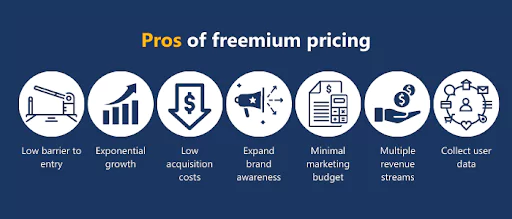 While the freemium model may work for some, other companies find it's better to put a time limit on how long users can test out your features. Free trials are considered one of the best forms of SaaS marketing and are especially beneficial to use during your bottom-of-the-funnel marketing efforts, in which your potential users are moving past the awareness stage and are actively engaging with their options to find the right solution to their problems.
4. Target and retarget
Once you've acquired a customer, then what?
Although every company's sales KPIs vary, customer acquisition cost (CAC) is typically about five times higher than customer retention cost. What that means for marketing is that your team should be spending as much time, if not more time, retargeting existing customers with upsells than going after new buyers.
When you consider the typical length of a B2B sales cycle, you can also see why it is beneficial to reach out to those who have already made a purchase. This is more important than ever now that the average sales cycle length is on the rise.
According to a survey by Theory Ventures, the average startup saw a 24% increase in the length of their sales cycle between 2022 and 2023. This statistic may indicate that companies are looking to decrease spending and taking more time researching SaaS products to ensure they're making the right purchases, which can potentially make it even more difficult to land a new customer.
Focusing on your current customers can help you navigate a potentially difficult market, and email marketing can be a big help in this regard. Organize and clean up your email list, then put together an email strategy that can help you upsell your existing customers.
Send out emails when you launch new features, when you're undergoing a rebrand, or any other time you think your customers may want to know about your upcoming news. You should also segment your list to ensure you're making the most of your connection. Reach out too much, and your customer may mark you as spam, which can hurt your relationship.
5. Marry customer success to SaaS marketing
Think of your customer success (CS) team as an extension of SaaS marketing.
CS teams can play a vital role in retention and retargeting. By having your CS team check in with existing customers and demonstrate that you care about your clients, they may be more interested in investing more time, energy, and money into your relationship. They're also a key source of feedback that can help your business come up with great product and marketing improvements.
You can even ask your clients to assist with your SaaS marketing endeavors. Consider starting a referral program, which can help you keep acquisition costs down, or asking your users to review your offering, which can help you get your name out there.
Word-of-mouth marketing is worth its weight in gold, especially in the SaaS industry. McKinsey found that word of mouth was the primary factor in up to 50% of all purchasing decisions. Growing your word-of-mouth advertising helps you stay competitive and continue to win new customers via your already-established ones.
Nailing SaaS Marketing in Our Subscription-Based World
SaaS marketing requires you to find advocates, nurture relationships, and rely on more inbound tactics. It also asks you to ditch the idea of selling a one-time-use product. You're selling a high-value solution, and your biggest goal in SaaS marketing is to get that across to the right clients, the key decision-makers at other companies.
SaaS will continue to advance, and with it will come changes in the way we market. However, one thing we must never forget is that B2B SaaS marketing, despite its techy roots and business focus, is a people-focused function. Foster the right relationships, and you'll reap the rewards.

.webp?width=600&height=375&name=Choose%20B2B%20agency%20for%20EdTech%20(1).webp)



Leave a Comment
Have thoughts on this article?
Share your feedback, ask questions, or join the discussion with our community.