





Outbound marketing is a marketing strategy focused on proactively reaching potential customers directly, unlike inbound marketing which attracts customers to you. Many businesses rely solely on inbound methods, but they may miss a segment of their target audience.
However, outbound marketing techniques can effectively connect with customers who have a problem but aren't actively seeking a solution.
Explore various outbound marketing strategies and how they can help attract potential customers to your brand.
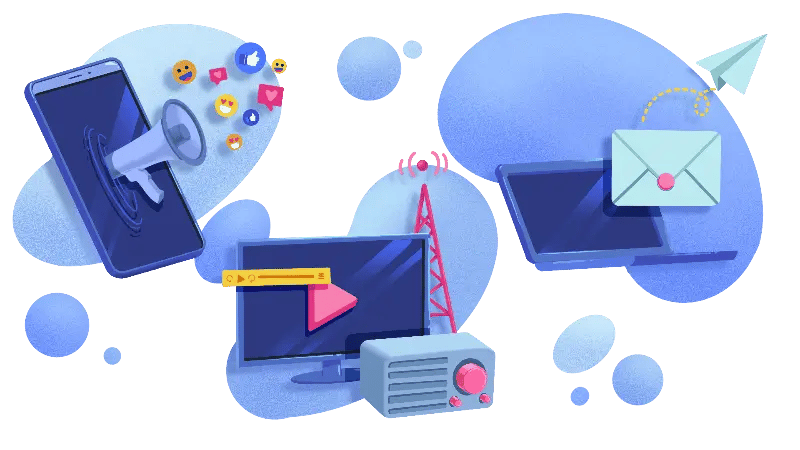
Traditional marketing tools like TV ads, social media, and direct mail are valuable for outbound marketing. The outbound marketing plan emphasizes building relationships by engaging with potential clients through targeted contacts. It calls for prioritizing your company's output above all other factors.
In the end, successful outbound marketing comes down to the outstanding execution of your strategy. Critical factors for that execution include:
Outreach Timing: Send the right message at the right time.
Know Your Customer: The better you know your potential customer, the more finely you can tune your campaign. You offer a particular product or service, and you're looking for clients who will ultimately buy that product or service.
Good Writing Sells: If your copy reads poorly, it will also sell poorly. Advertising is persuasive writing and should entice the ready. Your earliest task should be finding the right writers for your marketing group.
A Picture Is Worth 1,000 Words: More than half of us are visual learners. Get good pictures in your campaigns, and your battle is well underway. Sloppy or inappropriate visuals will turn away many readers.
Still, outbound marketing can be costly and too expensive for many new companies, and a campaign's success can be complicated to calculate. But, if your goal is somewhat amorphous to reaching a broad audience and increasing brand awareness, there isn't an excellent way to calculate that.
With its customer-driver contact, inbound marketing is becoming more significant every day. However, outbound marketing still accounts for over 90% of most firms' budgets because of its relatively high cost. To improve your return on investment in outbound ads, you must find strategies that will work well for your brand. We discuss three strategies to consider below. Ultimately, inbound marketing is about creating and distributing content to bring people to your website. Inbound's advantages of interactivity, tailoring, and easily measurable results leave it as clearly the growth side of the inbound versus outbound competition. Nonetheless, it is essential to consider keeping an outbound element in any corporate advertising program.
Social Media Advertisements
The users of social media sites and the sites they use have changed markedly over the past few years. However, no one can deny that any social media site will likely feature many people who aren't actively looking to purchase your product or service. Thus, running social media ads is a great way to contact the outbound market and develop a lead-generation program.
Social media advertising pushes your company to a much larger market base. Social media marketing has become integral to most firms' digital marketing strategies. As long as your social media complements and takes advantage of your website conversion engine, you should be able to deliver a comprehensive and persuasive message to your potential customers.
Both paid and organic social media campaigns increase your brand awareness and improve your firm's positioning with potential customers. Additional benefits include:
Targeted Advertising: Social media platforms allow businesses to target specific demographics, interests, behaviors, and locations, which can result in higher engagement and conversion rates.
Increased brand awareness: Social media advertising can help increase brand awareness and visibility by reaching a wider audience.
Cost-effective: Social media advertising can be more cost-effective than traditional advertising, such as TV or print ads. It also allows small businesses to reach similar-sized audiences as their larger competitors.
Are you interested in social media?

TV and Radio Advertising
Just because they've been around for a long time, TV and radio ads have not become useless. Actually, in some ways, they are more potent than ever. The increasing segmentation brought about by cable, streaming, and streaming audio services means that you can narrowly tailor a campaign to precisely the potential customer you need.
Furthermore, while younger people spend most of their "on-air" time on social media, adult American consumers still watch TV more than surfing social media. As always, your better choice depends on the client you want to attract. If that off-the-grid Royal Family fan also happens to be someone who watches The Crown or Victoria, you'll likely do better with a TV ad than a Facebook media buy.
Social media may be the king of the marketing universe today, but an awareness of your target demographics may lead you back to more traditional media. If your qualified outbound lead prefers TV to social media, you must have a presence there.
High reach: TV and radio advertising can quickly reach a large audience, effectively building brand awareness and driving conversions.
Audio-Visual Appeal: TV Advertising offers the advantage of audio-visual appeal, allowing businesses to create engaging, emotionally-compelling commercials that can resonate with the target audience; it can also convey a more complex message with the use of video
Targeted audience: TV and radio advertising allows businesses to target specific demographics and geographies by using specific shows or stations that cater to specific audiences, making it more efficient to reach the desired audience
Email Marketing
Of course, we only skim through emails and delete or archive most emails that hit our accounts daily. Still, email campaigns are rather inexpensive and can yield decent returns, especially once you've built an extensive "warm" emailing list.
Emails often get an average open rate of about one in five; better emails achieve an open rate of 30+% and click-through rates of more than 5%. Looking for marketing wins, Email Marketing comes with several benefits:
Targeted: Email marketing allows businesses to target specific groups of customers based on demographics, past purchase behavior, and other data.
Measurable: Email marketing campaigns provide detailed tracking and metrics, such as open rates, click-through rates, and conversions, allowing businesses to measure the effectiveness of their campaigns and make data-driven decisions.
Cost-effective: Email marketing can be relatively inexpensive compared to other forms of advertising, such as television or print ads.
High reach: Email allows businesses to reach many people quickly and effectively, as most consumers use email regularly.
Personalization: Email marketing allows businesses to personalize messages and offers to specific audience segments, resulting in higher engagement and conversion rates.
Does Outbound Still Matter?
Something must be working pretty well with outbound marketing. Think back to your day online. Begin with your office email account where, if you're average, you probably receive 12-40 advertising emails and do so daily.
Consider your social media time. How many ads have attracted your attention even when you weren't in the market for the product or service you're looking at? Finally, TV and radio ads still work; people see a product that might be better than the one they're using and follow up on that ad. Others have been in a car accident and see that an attorney can help them at no initial cost, spurring their outreach.
Outbound marketing fosters lead generation and helps you build goodwill and brand equity. It introduces your prospects to new products and services, building subliminal knowledge that will be triggered when needed. Outbound takes a lot from the entrepreneur, demanding a fine-tuned focus on the precise characteristics of your prospective client and building the campaign around exactly that client.
Outbound marketing continues to be an effective way for businesses to reach new audiences and generate leads, particularly when effectively paired with an inbound marketing strategy.
While inbound marketing has gained popularity in recent years, outbound marketing techniques like direct mail and telemarketing can still drive significant business results.
Despite the rise of digital marketing channels, outbound marketing can still play an important role in building brand awareness and driving conversions, as long as it's executed effectively and targeted to the right audience.

.webp?width=600&height=375&name=Choose%20B2B%20agency%20for%20EdTech%20(1).webp)




Leave a Comment
Have thoughts on this article?
Share your feedback, ask questions, or join the discussion with our community.