





How much of your hard-earned organic traffic is quietly leaking away right now? For enterprise content engines, the traditional approach to content maintenance is broken. We treat content creation as an active assembly line, but we treat content archives like stone monuments. Unfortunately, search algorithms and modern AI answer engines view static pages as decaying liabilities.
 Can you afford to let your highest-performing assets become obsolete? The concept of "set-and-forget" content is dead. To maintain premium visibility, modern marketing leaders must transition from manual, seasonal refreshes to autonomous content optimization loops.
The Silent Threat of Content Decay
The web moves faster than human editorial teams can keep up with.
A comprehensive Ahrefs study reveals a stark reality: 90.63% of all web content receives zero traffic from Google.
The primary culprit for pages that used to perform well but no longer do is content decay. Content decay is the gradual, compounding loss of historical keyword rankings caused by outdated statistics and aging contextual data.
Conversely, proactive maintenance yields massive returns.
According to HubSpot, organizations that actively prioritize a structured content refresh program can achieve an average organic traffic increase of 106%.
By automating content optimization, you turn a manual operational bottleneck into a scalable competitive advantage.
Why does perfectly optimized content lose its ranking velocity over time? The answer lies in how modern search systems process time-sensitive indicators. Single-page traffic follows a predictable lifecycle: Spike, Trough, Growth, Plateau, and inevitably, Decay.
Historical data shows that standard B2B content experiences an average weekly erosion rate of 1.21% in organic performance once it enters the decay phase.
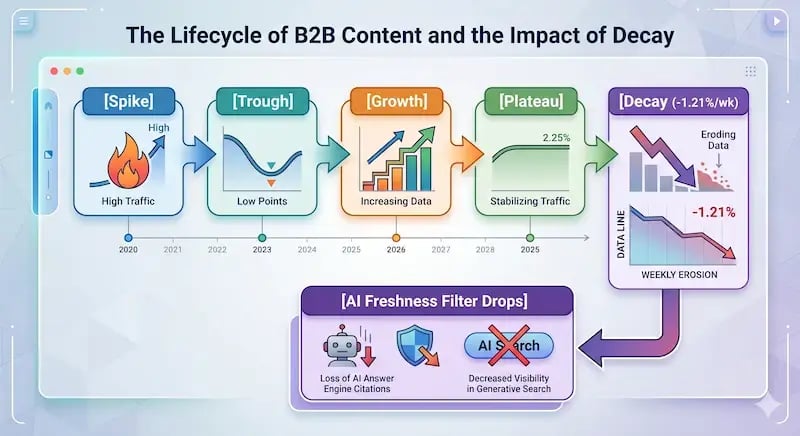 However, the problem runs deeper than traditional organic rankings. In the current search ecosystem, content creators face a dual-axis threat.
First, you face traditional search degradation. Google's internal indexing systems utilize a "Query Deserves Freshness" mechanism. When a page's core data points age, its relevance score drops relative to newer, competitor-driven assets.
Second, you face the AI citation penalty. Large Language Models (LLMs) and search features like Google's AI Overviews prioritize highly contemporary validation data.
Industry benchmarks indicate that 65% of AI bots hit target content published within the past 12 months, and 89% target content updated within the past 3 years.
If your page features data from three years ago, it is effectively invisible to the answer engines driving modern product discovery.
What is Answer Engine Optimization (AEO)?
To fight back against content decay, you must understand Answer Engine Optimization (AEO). AEO is the practice of optimizing your content for AI-powered search engines, chatbots, and voice assistants. Traditional SEO focuses on ranking links on a search results page. AEO focuses on getting your content cited directly inside the answer generated by an AI agent.
AI answer engines do not read text the way humans do. They use advanced natural language processing to extract facts, entities, and data points. If your content is vague, poorly structured, or outdated, the AI engine will skip it entirely.
To win the AEO game, your content must be clear and direct. You must present information in a format that a machine can easily verify. This means using simple sentence structures, clear definitions, and up-to-date facts. When you focus on automating content optimization, you ensure that your archive always meets these strict AI standards.
The Framework of an Autonomous Optimization Loop
How do we solve a compounding maintenance problem without expanding headcount? The answer is to replace human scheduling with programmatic, AI-driven workflows. By deploying automated schedules, companies can prompt autonomous AI agents to review, update, and patch aging statistical data across a massive blog archive without manual intervention.
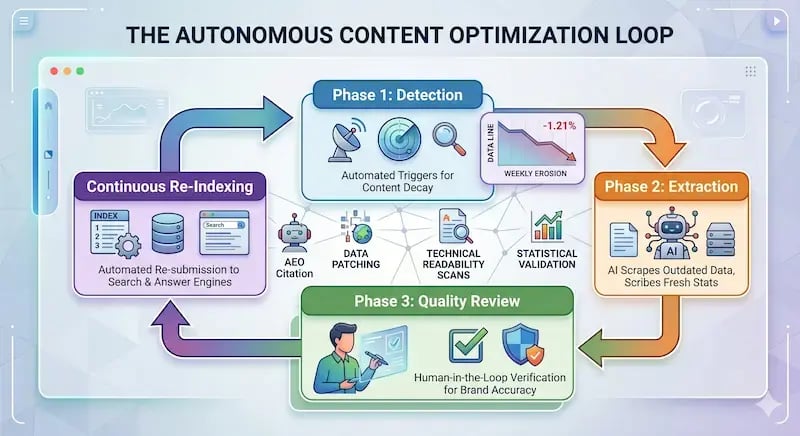 Phase 1: Algorithmic Detection and Trigger Schedules
Instead of waiting for an annual site audit, set up automated API triggers connected directly to your analytics suite. You can connect these tools to Google Search Console or your favorite SEO platform.
The trigger condition is simple. A programmable trigger fires whenever a URL exhibits a rolling 15% drop in impressions or clicks over a 60-day window. You can also set a trigger to fire when a page's last-modified metadata timestamp crosses the 180-day threshold.
This ensures that no piece of content sits idle for too long.
Phase 2: Deploying AI Agents for Statistical Patching
Once a page is flagged for decay, an autonomous AI agent is dispatched to read the live production text. The agent performs a quick technical-readability scan to isolate outdated statistical claims. For example, if the text says, "According to a 2021 survey," the agent flags it.

The agent then browses verified web databases via restricted search APIs to find the current metric from 2025 or 2026. Once it finds the new data, it rewrites the sentence using active voice and clear language. The agent also updates the hyperlinked source citation. This ensures the post links to active, authoritative reference material, thereby protecting your site's external validation graph.
Phase 3: The Programmatic Quality Gate
To safeguard brand integrity, automated content optimization loops should never push changes straight to live production without a verification layer. Your brand voice is too valuable to leave entirely to automation.
The AI agent generates a staged markdown file that shows side-by-side deletions and additions. An editor receives an automated alert via Slack or your content management system. The editor can review, modify, or approve the patch with a single click. This maintains a strict human-in-the-loop content workflow with safety protocols while keeping the workflow fast and agile.
Technical Architecture for LLM Readability
Automating content optimization requires structuring your digital ecosystem so that both search engine bots and AI agents can efficiently scrape and process your content. If your backend code is cluttered with bloated JavaScript, tracking pixels, or non-semantic HTML structures, your optimization loops will stumble.
To fix this, your pages must feature precise schema markup. Use specific tags like TechArticle or BlogPosting. You should also use distinct data attributes that label statistics clearly. When information is organized with clear technical readability, AI search crawlers can parse it much faster.
Research from Growth Memo highlights that 44.2% of all LLM citations are extracted from the first 30% of an article.
Your automated systems must prioritize surface-level data placement to maximize visibility. Put your core answers, main statistics, and direct definitions at the top of your posts.
Maintaining clean, machine-readable structures pays direct dividends.
Case studies demonstrate that optimizing for brand visibility and explicit citations in AI answer blocks can yield an organic Click-Through Rate (CTR) boost of up to 35% compared to non-cited competitors in the same search layout.
Designing Content for High Readability Scores
If you want AI engines to cite your work, you must also make it easy for humans to read. AI models are trained on human language, so they prefer text that flows naturally and avoids unnecessary complexity. Writing with high readability scores is no longer just a best practice for user experience; it is a core requirement for AEO.
To achieve a high Flesch Reading Ease score, you must focus on two main variables: sentence length and word length. Keep your sentences short and direct. Avoid long, winding sentences that try to make three points at once. Instead, break them down into separate, punchy thoughts.
You should also choose simple, clear words over complex jargon. Instead of saying "utilize," say "use." Instead of saying "subsequent to," say "after." This does not mean you should dumb down your insights. It means you should express deep professional expertise in the cleanest way possible.
Here are a few quick rules for maintaining high technical readability in your optimization loops:
-
Use Active Voice: It makes clear who is performing the action. Say "The agent updates the post," not "The post was updated by the agent."
-
Write Short Paragraphs: Limit paragraphs to two or three sentences. This creates visual breathing room on the screen and makes your content highly scannable.
-
Use Bold text Wisely: Emphasize key terms and core metrics to guide the reader's eye directly to the most important facts.
-
Create Bulleted Lists: When presenting multiple items or data points, use bulleted lists rather than dense prose blocks.
When your automated agents rewrite old paragraphs, they must follow these exact readability constraints. This double-optimization ensures that every refresh improves both your data accuracy and your structural readability scores.
Measuring the ROI of Freshness Loop Automation
Investing in an automated content optimization infrastructure requires clear business justification. How do you measure the success of your continuous refresh loops? You need to look at both traditional SEO metrics and modern AI visibility indicators.
First, track the turnaround time for your updates. A traditional manual content audit and refresh cycle can take weeks or even months to complete across a large archive.
With an automated loop, the time between detection and patching drops to less than 48 hours. This agility allows you to capture trending search traffic before your competitors even notice their rankings are slipping.
Second: Monitor your historical asset value. Instead of watching your old blog posts slowly sink into irrelevance, you will see a stabilized or upward-trending traffic pattern across your entire archive. This maximizes the return on your initial content investment. Every dollar you spent creating content in the past continues to generate leads today because the asset never expires.
Finally: Measure your AI share of voice. Track how often your brand appears as a cited source in AI search features and conversational platforms. As your automated loops replace stale stats with fresh data, you will notice a direct correlation between increased AI citations and higher-quality referral traffic.
Optimization Metric |
Manual Refresh Approach |
Automated Loop Approach |
|---|---|---|
Audit Frequency |
Annual or Quarterly |
Continuous & Real-Time |
Time to Update |
2–4 Weeks per Post |
Less than 48 Hours |
Data Accuracy |
Prone to Human Oversight |
Verified via Source APIs |
AI Citation Share |
Rapidly Declines Over Time |
Stays High Due to Freshness |
Common Pitfalls to Avoid in Content Automation
While automating content optimization offers incredible scale, you must watch out for common traps that can derail your strategy. Automation is a powerful tool, but it requires careful guardrails to protect your brand reputation.
Ignoring The Humans
The biggest mistake is relying on raw, unchecked AI output. Removing your Human-in-the-Loop entirely can lead to factual errors or awkward phrasing. AI agents are excellent at finding data and drafting revisions, but they lack the deep contextual understanding of an experienced editor. Always route updates through a staging environment where a human can quickly verify the changes before they go live.
Over-Optimizing for SEO/AEO
Another pitfall is over-optimizing for search engines while forgetting the human reader. Do not let your automated loops stuff keywords into every paragraph or ruin the natural narrative flow of your articles. The goal is to make your content more accurate and readable, not more robotic. If a sentence feels forced, rewrite it.
No. Broken. Links.
Finally, ensure your automated systems do not create broken links. When an AI agent updates a statistical source, it must verify that the new URL is live and trustworthy. Broken outbound links damage your site's authority and frustrate users, so link verification must be an integral part of your automation pipeline.
Transitioning to a Continuous Growth Model
Moving from a static publication mindset to a continuous optimization model requires a shift in company culture. Many marketing teams are evaluated solely on how many new pieces of content they publish each month. This metric is outdated and actively hurts your bottom line if your old content is rotting in the background.
To drive real growth, you must value maintenance as much as creation. Balance your content calendar so that a significant portion of your resources is dedicated to protecting your existing digital footprint. Celebrate when an automated loop rescues a declining high-value asset and restores its traffic velocity.
Think of your content archive as a dynamic portfolio of digital assets. Just as a financial portfolio requires constant rebalancing and monitoring to maximize yields, so does an investment portfolio. Automating content optimization gives you the tools to manage this portfolio at scale, ensuring every single page works hard to generate pipeline value.
Are you ready to stop content decay from eroding your inbound lead pipeline? Building these complex pipelines requires deep technical alignment between advanced AI architectures and disciplined SEO strategies.
To systematically deploy custom AI content agents, optimize your legacy archives, and establish fully automated content refresh loops that scale with your growth objectives, explore the enterprise optimization frameworks engineered by Aspiration Marketing. Transitioning to automated optimization loops will keep your content perpetually fresh, highly readable, and ready to dominate the future of search.







Leave a Comment
Have thoughts on this article?
Share your feedback, ask questions, or join the discussion with our community.