





In early 2020, Google's Chrome Team introduced the Core Web Vitals to provide quality signals for web pages. The Core Web Vitals are a set of specific, user-centric metrics that Google uses to measure a webpage's overall user experience. Recently, the Google Chrome team announced an upcoming change to these metrics to better evaluate the quality of a web page's user experience. This article explores this change and its meaning for Google Search and site owners.
A better responsiveness metric
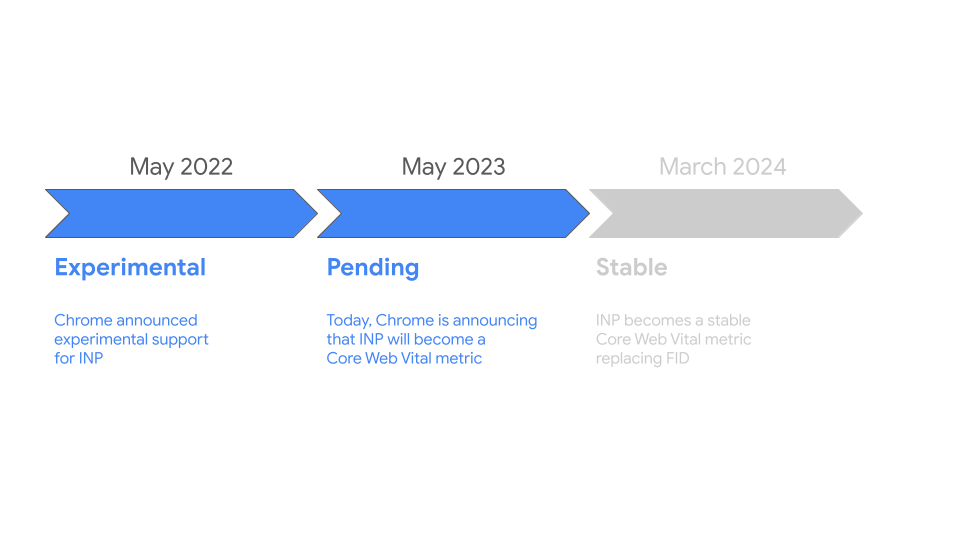
One of the Core Web Vitals metrics, First Input Delay (FID), measures responsiveness. First Input Delay (FID) is a metric that measures the delay before a page responds to the first user input, but FID has known limitations as it only considers the first interaction. To address this, the Chrome team explored a more effective experimental metric. In 2022, they announced Interaction to Next Paint (INP) as that new metric.
Interaction to Next Paint (INP) is a Core Web Vitals metric that assesses a page's overall responsiveness by measuring the time from when a user initiates an interaction until the next frame is painted on the screen. After a year of testing and gathering feedback, the Chrome team decided to promote INP as the new Core Web Vitals metric for responsiveness, effective March 2024, replacing FID. The Chrome team's blog post explains this change and the reasoning behind the new metric in more detail.

What this means for Google Search Console
The new metric, INP, will replace FID as part of the Core Web Vitals in March 2024. To help site owners and developers take the necessary steps and evaluate their pages for the new metric, Search Console will include INP in the Core Web Vitals report later this year. When INP replaces FID in March 2024, the Search Console report will stop showing FID metrics and use INP as the new metric for responsiveness.
What this means for site owners
If you have been following our guidance to improve Core Web Vitals, you will have considered the responsiveness of your pages already. The improvements made for FID are a good foundation to improve INP and the responsiveness of your pages.
We highly recommend that site owners achieve good Core Web Vitals for success with Search and ensure a great user experience. However, great page experience involves more than Core Web Vitals. Good stats within the Core Web Vitals report in Search Console or third-party Core Web Vitals reports don't guarantee good rankings.
To learn more about how Core Web Vitals fits into a holistic approach to page experience, see our guidance on page experience in Google Search results.
You can find more information about the new metric in the Chrome team's blog post and guidance on optimizing your pages regarding INP in this guide on optimizing INP.

----------------------Originally Posted by Martin Splitt, Developer Relations Engineer, Google Search Relations team.
Partially edited for clarity; links replaced with information on aspiration.marketing where available. Except as otherwise noted, the content of this page is licensed under the Creative Commons Attribution 4.0 License, and code samples are licensed under the Apache 2.0 License. For details, see the Google Developers Site Policies. Java is a registered trademark of Oracle and/or its affiliates.






Leave a Comment
Have thoughts on this article?
Share your feedback, ask questions, or join the discussion with our community.