





The digital world has erased geographical borders, presenting businesses with unprecedented opportunities for massive international expansion. You've achieved domestic success, and now the global stage is calling. But here's the critical question: are your current marketing strategies built to capture an international audience, or are they inadvertently limiting your reach?

The truth is, simply having a great product or service is only the beginning. To truly conquer new markets and secure significant global market share, you must go beyond basic outreach. You must speak to people in their native language and, more importantly, understand their culture. This isn't just a linguistic challenge; it's the definitive strategy for building high-impact global business growth content.
Consider this powerful insight from CSA Research:
72% of consumers are more likely to purchase a product with information available in their native language.
That percentage represents a colossal amount of untapped revenue for businesses that rely only on English or simple translations.
This guide explores how content marketing acts as the essential engine for global scaling. We will show you why moving past basic translation and adopting a strategic framework of multilingual marketing is the most critical step you can take today to drive sustainable and profitable international growth.
The Global Mindset Shift: Understanding the Core Pillars of International Content
Why do so many companies, even those with large budgets, fail to successfully scale internationally? The most common error is mistaking translation for a strategy. They simply convert their existing US or UK content into a new language and expect immediate results. This approach consistently underperforms.
Successful global business growth content is built on two key distinctions: realizing the difference between simple translation and strategic multilingual marketing, and understanding the powerful benefits of localization over general globalization.
Distinguishing Strategy from Simple Language Transfer
Translation is the process that ensures linguistic accuracy. It converts words and sentences accurately from the source language to the target language. This is a necessary first step, but it is purely tactical. It ignores the market context, the cultural norms, and the buyer's motivations.
Multilingual marketing is a comprehensive, strategic approach. It focuses on adapting your entire message, your visuals, and your marketing funnels to resonate deeply with specific cultural nuances and buyer behaviors in that market.
This cultural adaptation immediately delivers a powerful return. Studies show that when companies implement proper multilingual marketing and tailor communications—such as sending personalized emails in the recipient's native language—they see dramatic boosts in key metrics.
Personalized, native-language communications increase open rates by 29% and click-through rates by 41%.
That is the measurable difference between merely translating and strategically engaging.
Localization vs. Globalization: The Art of Thinking Global, Acting Local
To achieve sustainable global growth through content marketing, it is essential to understand the interplay between globalization and localization.
Globalization is the 'wide net' approach. It focuses on standardization, creating a uniform product or service designed for universal appeal. It answers the question: What are we selling internationally?
Localization is the 'tailor-made' approach. It's the essential strategy for increasing market relevance. Localization adapts your content, imagery, pricing structure, and user experience for a specific target locale. It answers the question: How will we sell it effectively in this particular region?
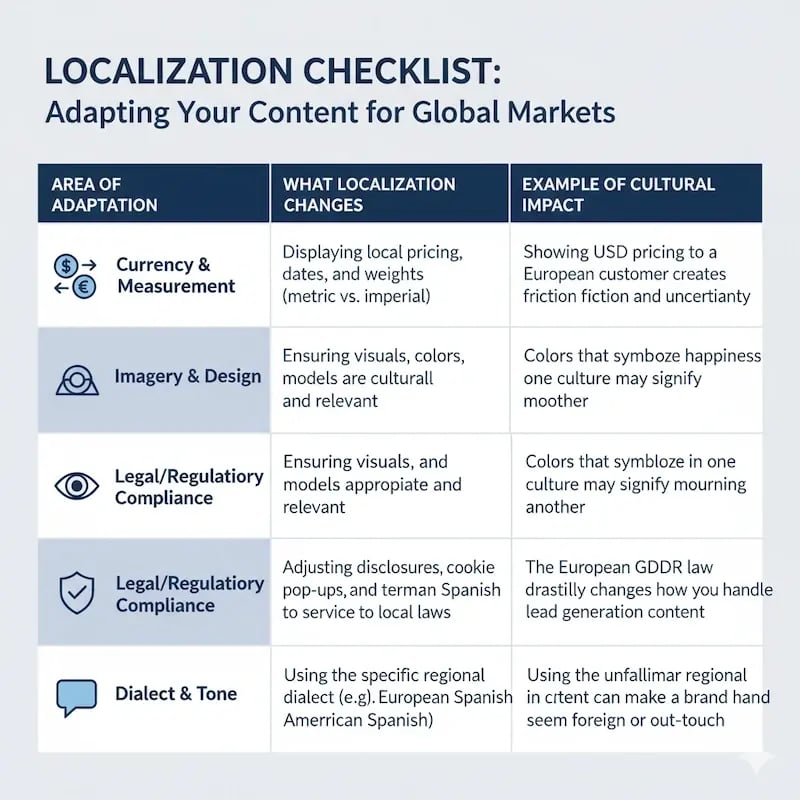
This investment in relevance pays off instantly. Why? Because it builds immediate trust. Companies that invest in proper localization see significant bottom-line results, reporting an average increase of 10–30% in conversion rates. This proves that relevancy converts far better than standardization.
Building the Engine: How to Create Content for International Expansion
To create impactful global business growth content, you need a practical, three-pillar framework. This blueprint merges content creation, the philosophy of inbound marketing, and necessary technical digital optimization.
Pillar 1: Content Creation and Cultural Relevance
The first step in global growth via content marketing is mastering content creation for new markets. This means moving beyond simple translation and adopting transcreation.
Transcreation: Transcreation is the creative adaptation of content to ensure it evokes the same emotional response and carries the same intent in the target language as it does in the source language. It's about cultural relevance, not just linguistic accuracy.
Local Buyer Personas: Your successful domestic buyer personas cannot simply be translated. You must create genuinely localized personas that account for unique cultural context, local challenges, specific market dynamics, and regional preferences. What unique pain points are particular to this market?
Awareness Stage Focus: Since the goal is awareness, your initial content must focus on solving universal problems while demonstrating a nuanced, local understanding. Great awareness-stage content for international markets includes:
Localized market research reports relevant to the target region.
Case studies that feature a regional client or address a local industry challenge.
Thought leadership content quoting local experts or covering local regulations.
Pillar 2: Inbound Strategies for Global Lead Generation
The philosophy of inbound strategies—attracting leads by providing value, rather than aggressively interrupting them—works globally. However, the execution must be tailored to the new market.
Localizing the Funnel: An aggressive Call-to-Action (CTA) that works in a high-urgency market like the United States might be too direct or off-putting in a relationship-driven market like Japan. You must adapt your lead magnets and CTAs to align with regional communication preferences.
Example: Instead of a prominent CTA that says, "Buy Now," a soft-touch approach, such as "Request a Discovery Guide" or "Download the Local Market Trends Report," might yield higher-quality leads in new regions.
The Power of Localized Value: Your localized landing pages, educational guides, and assessment tools are the engine of your global business growth content. These assets, when properly localized, build immediate trust and capture leads effectively in new regions.

Pillar 3: Technical SEO for Multi-Region Domination
You can have the most culturally brilliant content in the world, but it will not drive results if search engines cannot find or categorize it correctly. Visibility is paramount. Search engines are inherently localized, meaning your SEO optimization must be, too.
The Non-Negotiable: Hreflang Tags: An hreflang tag is one of the most critical technical requirements for international SEO optimization. You must inform search engines (such as Google and Bing) which version of your page is intended for a specific region and language. Correctly implementing hreflang tags prevents duplicate content issues and ensures that a user in France sees the French version of your website content, maximizing the impact of your multilingual marketing efforts.
Domain Structure Decisions: Strategic decisions must be made about where to host your content. Should you use:
ccTLDs (country code top-level domains, e.g., example.de)?
Subdomains (e.g., fr.example.com)?
Subfolders (e.g., example.com/es/)?
Each option has different technical advantages and disadvantages related to cost, authority, and ease of management.
Local Keyword Research: Never rely on translating domestic keywords. You must conduct native-level keyword research. Translated keywords often fail to reflect the search terms that local consumers actually use accurately. Actual local keyword research is essential for maximizing organic traffic and ensuring your global business growth content ranks.
This meticulous approach delivers tangible results:
Companies that translate their websites into at least two languages, and correctly optimize them, see an average increase of 15% in website traffic within the first year.
Quantifying Your Success: Proving the ROI of Global Content Investment
The ultimate objective of global business growth content is not just visibility; it is measurable, profitable results. How do you effectively track the success of your investment in strategic multilingual marketing?
Conversion Rate by Language/Region: This is the single most important metric. Is the localized Spanish version of your landing page converting leads at a higher rate than your original version? This data directly confirms that the investment in localizing the experience is paying off, validating the 10–30% conversion boost often seen with localization.
Localized Organic Traffic: You must track traffic segmented by the language version visited using segmented analytics. This confirms that your technical SEO optimization is functioning and that you are successfully attracting new visitors through organic search in that specific market.
Customer Lifetime Value (CLV) per Market: A well-executed, relevant content experience builds greater trust and brand loyalty in new markets. This increased trust often translates into a higher Customer Lifetime Value in the markets you have successfully localized.
Reduced Support Costs: Well-localized content does more than just sell. Providing high-quality, native-language product documentation, FAQs, and help center content significantly reduces the inbound workload on international support teams. For example, a company might see a 20% drop in inbound support tickets from the German market after fully localizing its help center.
Content is a long-term asset. While paid advertising delivers instant traffic, valuable, global business growth content—supported by sustainable inbound strategies—creates an asset that continually drives high-quality leads, lowers your Customer Acquisition Cost (CAC) over time, and solidifies your authority in each new market.
Accelerate Your Global Journey with Strategic Expertise
Expanding your business internationally is arguably one of the most complex strategic challenges a company faces. It requires more than a dictionary, a standard budget, or a simple marketing checklist. It demands a unified strategy that seamlessly blends high-impact content creation, deep cultural acumen, technical digital optimization, and proven inbound strategy.
The simple act of translation is a transactional cost. Developing a comprehensive multilingual marketing strategy is a strategic, critical investment that drives sustainable global business growth.
Are you ready to stop guessing and start executing a proven international growth strategy? Are you prepared to move beyond basic translation and leverage a strategic partner capable of merging these complex disciplines into a cohesive, measurable plan?
For businesses ready to conquer international markets, strategic guidance is not optional—it is essential. Our approach is unique: we craft and execute comprehensive multilingual marketing strategies designed to help businesses successfully navigate and conquer international markets. We specialize in the unique blend of high-impact content marketing, proven inbound strategy, and meticulous digital optimization. Aspiration Marketing offers expert insights and proven tactics for achieving significant international growth, positioning our services as the strategic solution for achieving global business success.







Leave a Comment
Have thoughts on this article?
Share your feedback, ask questions, or join the discussion with our community.